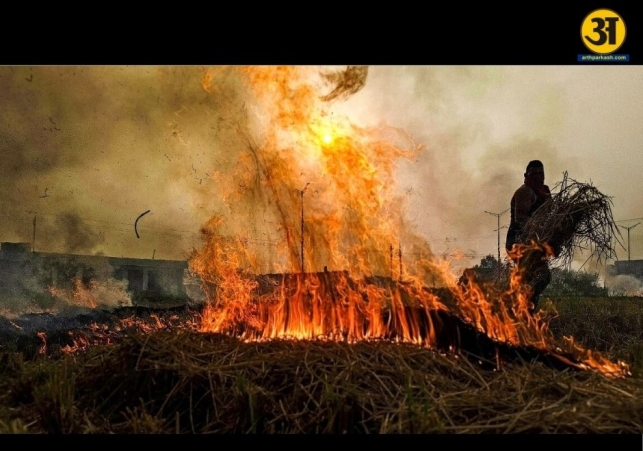
Punjab sees majority of stubble fires in November
Over half of this season’s stubble-burning cases recorded in Punjab during November
- By Gurmehar --
- Friday, 14 Nov, 2025
Punjab has reported a sharp rise in stubble burning incidents this season, with nearly 56% of all farm fires occurring between November 1 and 13. According to data released by the Punjab Pollution Control Board (PPCB), the state recorded 2,650 cases of stubble burning during this period, even though 82% of the paddy crop covering 31.72 lakh hectares had already been harvested by October 31.
This increase comes after the Supreme Court asked Punjab and Haryana to update it on the measures taken to control stubble fires, which contribute significantly to air pollution in Delhi-NCR. A bench led by Chief Justice B.R. Gavai and Justices K. Vinod Chandran and N.V. Anjaria will hear the case on November 17. The court directed both state governments to respond with detailed reports about their efforts to reduce burning.
Before November, from September 16 to October 31, Punjab had logged 2,084 stubble fire incidents. Normally, stubble burning peaks in October, after the paddy harvest, when farmers clear fields for the next wheat crop. However, this year, harvesting was delayed due to poor weather, leaving farmers with less time to prepare their fields. A senior PPCB official said, “It is surprising that more than half of this season’s stubble fires happened in just the first two weeks of November.”
The impact of stubble burning on air quality has been severe. On Wednesday, Delhi recorded ‘severe’ air pollution for the second day in a row. Smoke from Punjab and Haryana contributed nearly 25% of the city’s PM2.5 levels, the highest this season, according to the Centre’s Decision Support System (DSS). This is a significant jump from earlier in the week, when stubble burning contributed 13-15% to Delhi’s PM2.5 levels.
Government actions and penalties for farmers
The Punjab government has taken several steps to reduce stubble burning. Authorities advanced paddy procurement by 15 days and allowed early sowing of the crop. Despite these measures, stubble fires surged in early November due to the delayed harvesting season.
From November 1 to 13, authorities registered over 1,100 FIRs against farmers for violating stubble-burning rules under Section 223 of the Bharatiya Nyaya Sanhita (BNS). In addition, 1,436 red entries were recorded in the revenue records, bringing the total punitive actions to 1,991. Environmental compensation fines totaling ₹65.5 lakh were imposed in November alone, part of a broader total of ₹1.06 crore levied this season on 2,038 cases.
ALSO READ: India’s love for sugary chai continues even as diabetes cases climb
ALSO READ: Delhi’s winter pollution may lower your body’s natural defenses, say doctors
The state government will present a detailed action report to the Supreme Court, including information about fines, penalties, and enforcement measures. Despite the early November surge, the overall number of stubble-burning incidents in Punjab has dropped 57% compared to last year, when 10,909 cases were reported. Over the past five years, incidents have decreased by 93%, down from 71,000 cases in 2020, showing the long-term impact of stricter enforcement and awareness campaigns.
Experts say that stubble burning continues because farmers need to clear fields quickly to sow wheat. Time pressures, lack of alternatives, and financial constraints often force them to burn crop residue. Long-term solutions, such as mechanical stubble removal, bio-decomposers, and financial incentives for sustainable farming, are needed to make a lasting impact.
In conclusion, while Punjab has made progress in reducing stubble burning, the spike in early November shows that continuous monitoring, strict enforcement, and support for farmers remain critical. The Supreme Court’s oversight ensures that both Punjab and Haryana maintain accountability in protecting air quality and public health. Authorities hope that combining fines, awareness campaigns, and practical alternatives will further curb stubble burning in the coming years.
Related News